Who Decides What is Visible?
Line of Inquiry
Bodily Autonomy, Law, and Public Space
Introduction
Every society draws visible and invisible boundaries around the body.
Some are written into law. Others exist as habits, expectations, religious traditions, or public opinion. Together they shape where bodies can appear, what they can do, and how they are expected to exist in public.
This line of inquiry explores the relationship between bodily autonomy and systems of authority. Rather than asking only what the law says, it asks how different forms of power become visible through the body—and how the body becomes the place where those powers are negotiated.
Central Question
Who decides what is visible? Who has the authority to regulate the body's presence in public?
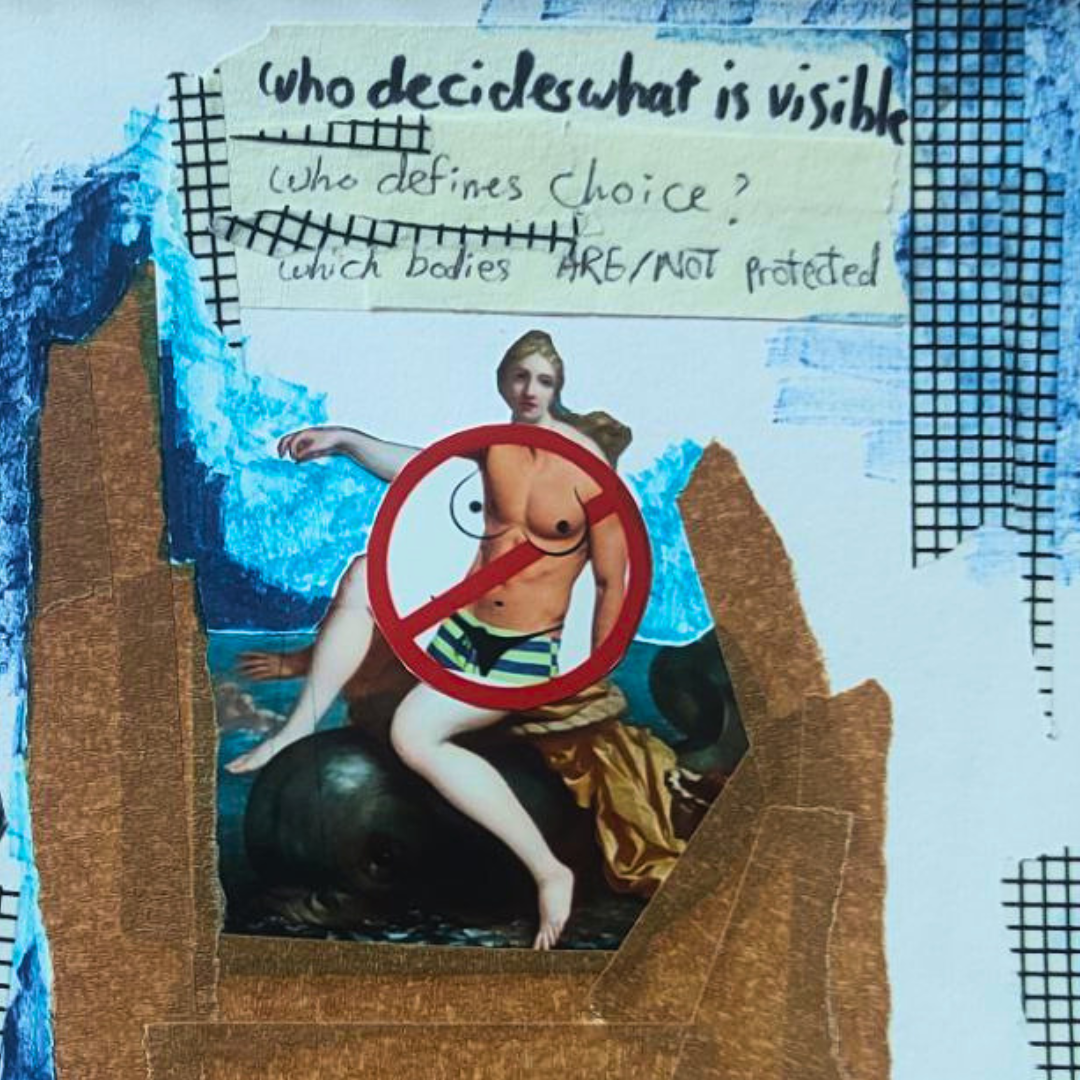
Early collage study exploring how systems of power negotiate bodily visibility.
About this Line of Inquiry
The body is never entirely private.
It moves through legal systems, public institutions, religious traditions, healthcare, education, borders, and shared social spaces. Each of these systems defines its own conditions for visibility, often overlapping and sometimes contradicting one another.
Rather than treating law as an isolated structure, this line of inquiry considers it alongside the quieter forms of regulation that shape everyday life. Written legislation and unwritten expectations often work together, producing boundaries that feel natural even when they are historically constructed.
Through archival research, collage, and image-based practice, this research asks how authority becomes visible through images, and how images, in turn, reinforce authority.
Research Directions
Bodily autonomy
Public space
Law and legislation
Reproductive rights
Public morality
Religious regulation
Institutional authority
Borders
Rights and restrictions
Visible and invisible rules
Current Investigation: Concept Development
This line of inquiry is currently developing its conceptual framework through research into legal history, public space, and the visual language of authority.
Particular attention is being given to the relationship between written law, institutional power, and the everyday regulation of bodily visibility.
Counter-Archive in Progress
The counter-archive gathers legal documents, historical imagery, institutional language, newspaper material, visual annotations, and collage fragments.
Rather than illustrating legal history, it asks how authority becomes embedded in images, and how visual practice might expose or interrupt those structures.
Current Outputs
Concept development
Research mapping
Visual references
Early collage studies
Reading notes
Project Manifestations
London: Law and Public Space
Originally developed for the Quinn Emanuel Artist-in-Residence programme in London, this proposal explores the relationship between bodily autonomy, legal frameworks, and public visibility.
London serves as a research context where legal systems, institutional power, and overlapping cultural traditions converge, providing a starting point for investigating how authority becomes visible through the body.
Research Archive
Current investigations connected to this line of inquiry will gradually appear here.
This line of inquiry is less concerned with what bodies are than with who has the power to define them.
By examining the spaces where law, culture, and public life intersect, it asks how visibility becomes governed—and how that governance might be challenged through visual practice.